Showing posts with label prisoner. Show all posts

Friday, 26 August 2016

Iran:Disabled Mother of Iranian Prisoner of Faith Begs for the Release of Her Son

Disabled Mother of Iranian Prisoner of Faith Begs for the Release of Her Son
In an article by Stoyan Zaimov, in the August 24 Christian Post, he writes about the plight of a disabled mother of a Christian prisoner in Iran.  Her son is held in Rajaei-Shahr prison, and she has been unable to visit him because she is visually impaired.
As reported by Mohabat News on Tuesday, Ebrahim Firouzi, is one of several people imprisoned because of their Christian faith. Because he was not allowed access to his defense documents, he refused to attend his appeals court hearing. His appointed judge was not present, so the hearing has been postponed for four months.
According to the National Council of Resistance of Iran, Firouzi was arrested in August 2013, and sentenced to five years in prison in 2015. he was charged with "acting against national security," a charge often given to prisoners of faith in Iran.
Firouzi's mother pled with officials to handle her son's case fairly and to release him.  "Crying as she delivered the message to the authorities, Mr. Firouzi's elderly mother said that she is visually impaired and there is nothing she can do and has no one to help her. She said she doesn't have the ability to go from court to court and follow up on her son's case," Mohabat News reports.  "She added that she misses her son and because of her disability she has not been able to visit her son in prison. She pleaded with the authorities to release her son so he can come home.”

Monday, 4 July 2016

Iran: Political prisoner Ali Moezzi invites all to participate in “Free Iran” gathering

political prisoner Ali Moezzi
Iranian political prisoner Ali Moezzi, who is father to two members of the main Iranian opposition group People’s Mojahedin Organization of Iran (PMOI or MEK), has sent a message from Tehran’s notorious Evin Prison declaring his support for the annual gathering of the Iranian Resistance held in Paris on 9 July.

Tuesday, 28 June 2016

‘Free Iran’ rally gives voice to those still suffering in Iran

Free Iran’ rally gives voice to those still suffering in Iran
Farzad Madadzadeh, a former Iranian political prisoner, who escaped Iran last year, has written his account of why he plans to join tens of thousands of Iranians and their international supporters at the July 9 "Free Iran" rally in Paris.
In an op-ed for The Hill on Tuesday, Mr. Madadzadeh wrote: "Needless to say, it is a significant international event regarding an important international issue. But for me it is very personal. In spirit, I will be with a much larger crowd. We will be joined by a countless Iranians still living under the thumb of the theocratic regime, who will risk reprisals to watch the proceedings on banned satellite television channels."
"How do I know? After this year’s rally, I will have seen the event from both sides of the ideological wall that separates the Islamic Republic from most of the rest of the world. In past years, I was among those Iranians who supported the NCRI and its main constituent group, the People’s Mojahedin Organization of Iran (PMOI or MEK), from a silent place inside the country. I put my safety and freedom at risk, as did many of my colleagues, to carry on the groups’ local activism. I spent five years in jail from 2009 to 2014 and suffered extensive physical and psychological torture for my support for the PMOI.  I fled Iran at the age of 29 last year."

Wednesday, 25 May 2016

IRAN: Nearly a month into hunger strike the health of Iranian political prisoner is deteriorating


Jafar Azimzadeh, imprisoned at the notorious Evin Prison


The health of an Iranian political prisoner on indefinite hunger strike is in grave danger.
Jafar Azimzadeh, imprisoned at the notorious Evin Prison in Tehran, is on Day 26 of his hunger strike protesting Tehran’s crackdown on union activity.
On Saturday, he was taken to hospital complaining of kidney pain but refused to have liquid serum administered and was transferred back to the prison, still in pain.
His wife reports that in addition to his kidney problems, Mr. Azimzadeh has lost a considerable of weight, his blood pressure has dropped and he is having vision problems.
The Tehran bus drivers’ union, the Syndicate of Workers of Tehran and Suburbs Bus Company (Sherkat-e Vahed) called for Mr. Azimzadeh’s release from prison and warned the public that his health had been greatly affected by his strike.
Mr. Azimzadeh, a workers’ rights activist, is being heavily pressured by the regime to end his strike. As previously reported on Stop Fundamentalism, Tehran’s prosecutor's office demanded that he stop the hunger strike after he was unable to walk from his cell on Ward 8 to the visitor’s hall to see his wife, on May 17.
They even offered him the chance to take long-term leave from prison, not out of concern for his health but because they are scared of him becoming a ‘martyr’.

Tuesday, 10 May 2016

IRAN: Camp Liberty - Laila Mohammadi: The echoes of a common cause

Laila Mohammadi: The echoes of a common cause
Hello. This is my flute!
It appears to be a musical instrument but in fact, it is an efficient weapon that has harmonized hearts of the freedom fighters
with the Iranian people and people all over the world.
I played my flute in a beautiful sunrise in Ashraf. Within a short time I saw a young boy playing the same tune in Iran and then I heard its echo all over the world…! I call this reverberation, one of a “common cause”.
I found this common cause in my childhood. I learned it from my father who was a political prisoner at the time. I found it in the sad eyes of “Farshid”, a poor young boy with little clothing in the brutal cold winter. He was selling goods for a living in front of my high school. Farshid would sell pens in the morning and in the evening he would polish shoes on the street. There are many “Farshid”s in Iran. Yes. In Iran, there are many children and young adults whose childhood and dreams have been changed to gloom and dark prospects because of poverty.

Monday, 11 April 2016

IRAN:Letter of protest by Iranian political prisoner Reza Akbari Monfared to Italy’s PM


Letter of protest by Iranian political prisoner Reza Akbari Monfared to Italy’s PM
NCRI – The following is the English translation of a letter of protest by Iranian political prisoner Reza Akbari Monfared to the Prime Minister of Italy over his planned trip to Iran.
Mr. Akbari Monfared has written the letter from Iran’s notorious Gohardasht Prison in Karaj, north-west of Tehran, to Prime Minister Matteo Renzi reiterating that the Italian Premier’s trip to Tehran on Tuesday would only embolden the mullahs’ regime to commit more crimes.

Monday, 4 April 2016

IRAN: Political prisoner pays tribute to Iran’s heroes in Camp Ashraf

Political prisoner Ali Moezzi, father of two PMOI members, wrote in his tribute:
          Political prisoner Ali Moezzi, father of two PMOI members, wrote in his tribute
NCRI - Prominent Iranian political prisoner Ali Moezzi has sent out a message from Tehran’s notorious Evin Prison to commemorate the fifth anniversary of the April 8, 2011 attack by the Iraqi army against members of the main Iranian opposition group People’s Mojahedin Organization of Iran (PMOI) in Camp Ashraf, Iraq.
The unprovoked attack on the unarmed and defenseless PMOI (MEK) members in Camp Ashraf, which was carried out at the behest of the mullahs’ regime in Iran, left 36 camp residents killed and hundreds of others injured. The attack was condemned by the international community
Political prisoner Ali Moezzi, father of two PMOI members, wrote in his tribute:
On the fifth anniversary of April 8, 2011, we commemorate the epic valor and sacrifice of PMOI members. We bow our heads in recognition of the sacrifice of PMOI members that destroyed the fundamentalists’ conspiracies. Their blood, mixed with the blood spilt on the asphalt streets of our country and that of the executed political prisoners, will ensure a glorious future for Persia. From Saba Haftbaradaran who bled to death in front of her father’s eyes and lived true to her statement that we will stand resolute to our last breath; to Marzieh who valiantly rushed to her slaughter place and instantly died; to the Madadzadehs and other courageous heroes who were overrun by the [Iraqi] HUMVEEs. What a valiant stand they took at the scene.

Monday, 22 February 2016

Women's News Iran: 74 lashes, three months jail for mother of political prisoner and human rights activists

Iran: 74 lashes, three months jail for mother of political prisoner and human rights activists
18 human rights activists including families of political prisoners and martyrs were sentenced each to 91 days imprisonment and 74 lashes.
They had participated in a peaceful gathering outside Tehran's Evin Prison on November 21, 2015, demanding abolition of death sentence for prisoner of conscience Mohammad Ali Taheri, and freedom of all political prisoners.

The 18 convicted activists included Mrs. Simin Aiyvazzadeh (mother of political prisoner Omid Ali-Shenas), Azam Najafi, Parvin Soleimani, Sara Sa'ee, Farideh Toosi and Zahra Modarres Zadeh. They were charged with "illegal gathering disrupting public order."

Wednesday, 3 February 2016

Iran: Female Kurd prisoner may lose kidney

Safiyeh Sadeghi,
Safiyeh Sadeghi,
Rouhani has bragged about forcing women to wear veil #No2Rouhani #StopExecutionsIran
SafiyehSadeghi, a female Kurdish prisoner currently detained in Sanandaj Prison, western Iran,
is suffering from a number of illnesses and yet the authorities are not permitting her transfer to a hospital.
Sadeghi has been detained in Sanandaj prison for five years now. This female prisoner is suffering from kidney and heart illnesses but the officials have not permitted her to receive treatment in a hospital outside the prison to this day.
Many times she has requested from prison officials to be sent to a medical center outside of prison, yet to this day they have not permitted such a transfer,” one of her cellmates said.
“If she is not permitted to be hospitalized she may lose both of her kidneys and her health will soon be going to be in danger,” the prison clinic physician

Thursday, 7 January 2016

Iran: Negar Haeri, former political prisoner is deliberately ran over

Iran: Negar Haeri, former political prisoner is deliberately ran over
The news has just got out that Negar Haeri, a lawyer and former political prisoner, was deliberately ran over by unidentified persons on December 17, 2015.
She had previously been threatened time and again and finally on December 17, she was chased by a black Peugeot 405 with dark windows and hit after she got out of her car in Shahrara district. The Peugeot then sped away and disappeared.
Ms. Haeri was subsequently transferred to hospital. She suffered a broken right arm and a broken left leg and bruises all over her body.
Ms. Haeri had been summoned on phone to Evin’s Prosecutor’s Office on May 18, 2015, where she was insulted and arrested in front of her mother. She was held in the Evin’s women’s ward for one day and transferred to solitary confinement for another nine days where she was interrogated under torture. She was ultimately released on May 27, 2015.
Before this, she spent eight months in Varamin’s Qarchak prison and was released only after much efforts and on a 2billion-touman bail.
Ms. Haeri’s license for law practice was annulled and she was not banned from giving legal advice to her clients. Security and intelligence officers have instructed her not to leave Tehran in any circumstances.

Wednesday, 30 December 2015

Iran political prisoner denounces demagoguery in Christmas message

Ali Moezzi, an Iranian political prisoner in Tehran's notorious Evin Prison,
Ali Moezzi, an Iranian political prisoner in Tehran's notorious Evin Prison, has sent a message on the occasion of Christmas, denouncing the Iranian mullahs’ reactionary interpretation of religion.
Two of Mr. Moezzi daughters are members of the main Iranian opposition group People's Mojahedin Organization of Iran (PMOI/MEK) in Camp Liberty, Iraq. Mr. Moezzi is held in Ward 8 of the dreaded Evin Prison.
His message reads in part: “Greetings to my Christian and Muslim compatriots on the occasion of the birth of Jesus Christ. The birth of Christ which coincided this year with the birth of Islam’s Prophet Mohammad is a cause for double celebration. These prophets were harbingers of mercy and emancipation and equality and unity. Being reactionary is incompatible with the path of the prophets who are the pioneers of historical progress. The mullahs ruling Iran and Salafist and blood thirsty fundamentalists do not know Christ or Mohammad or Abraham. They foster despicable and ugly qualities in people and promote demagoguery. In anticipation of these festive days, we ask God to eradicate this scourge of the era and help us to establish friendship, co-existence, peace and cooperation between human societies."
Mr. Moezzi who suffers greatly due to obstruction of the intestines was prevented last month by the regime’s henchmen from being transferred to hospital. Following protests by political prisoners in Evin, he was taken to the prison infirmary, but was returned to the ward shortly afterwards without receiving any treatment.
Mr. Moezzi who is a political prisoner of the 1980s suffers from various diseases, including cancer and acute kidney disease, due to years of torture and imprisonment in the Iranian regime’s dungeons. Nonetheless, along with a number of other political prisoners, he staged a hunger strike last month to protest the suppression and the arrest of families of political prisoners and their supporters.

Saturday, 26 December 2015

Iran - Inhuman treatment of Christian prisoner in Iran’s notorious gulag

Ebrahim Firouzi, an Iranian Christian prisoner
EbrahimFirouzi, an Iranian Christian prisoner in the notorious Gohardasht (Rajai Shahr) Prison in Karaj, north-west of the Iranian capital Tehran, is being deprived of medical treatment by the mullahs’ regime although he suffers from acute diseases, according to local reports.
It is over a year now that he is suffering of acute pain in the left side of his chest and his condition has deteriorated in the past three months.
Mr. Firouzi was arrested on August 25, 2013 and condemned by a court in Robat Karim, south-west of Tehran, to one year in prison and two years exile in Sarbaz County. Although his prison term ended on January 13, 2015, he is still being kept in prison. New bogus charges were raised against him on March 8, 2015 for ‘acting against national security’ through community means, and he was subsequently condemned to five years in prison by the henchman-judge Moqiseh in Branch 28 of the regime’s courts.
He is currently in detention in Ward 10 of Gohardasht.

Wednesday, 23 December 2015

Iran: New case filed against Nargess Mohammadi


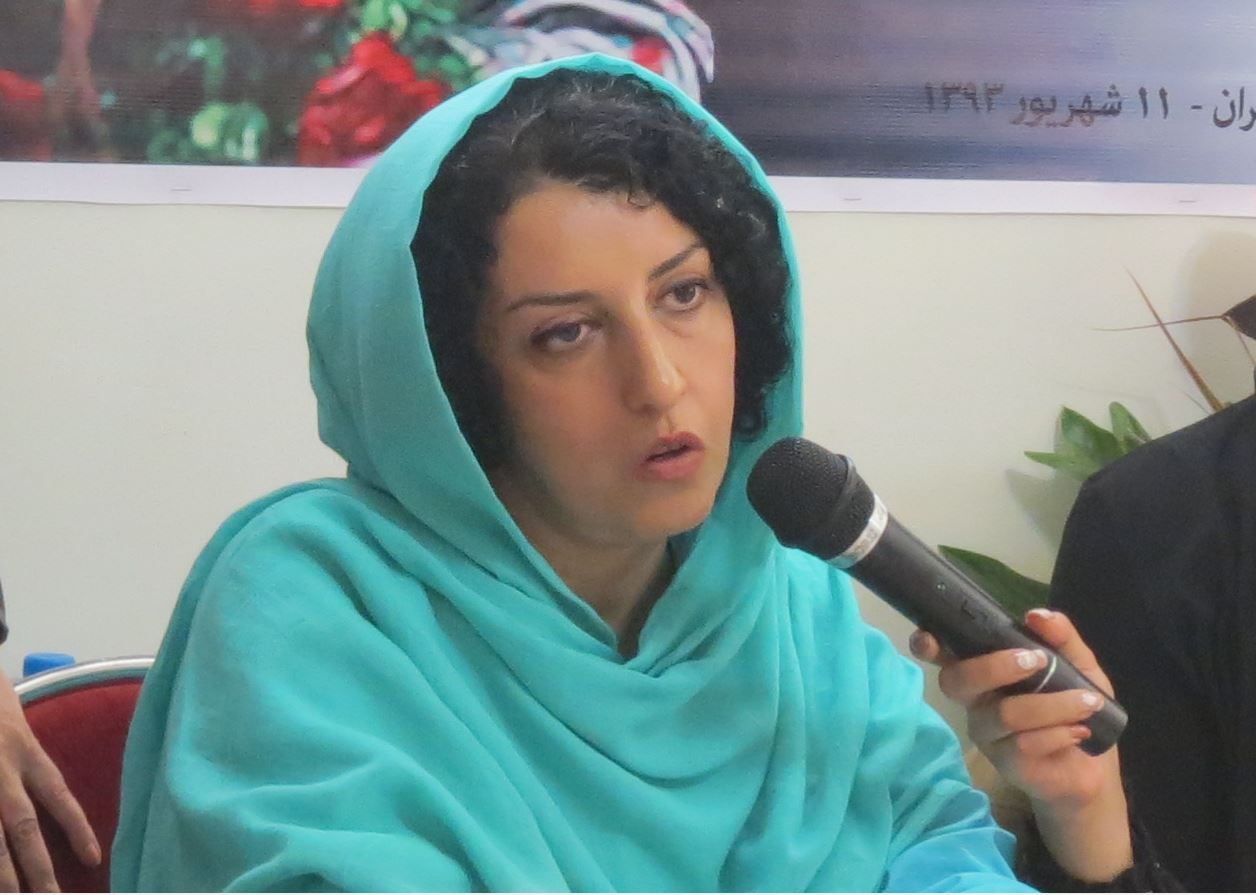
political prisoner Nargess Mohammadi
Prison guards who transferred political prisoner Nargess Mohammadi to hospital for treatment have filed a complaint against her, arousing her protest.
Ms. Mohammadi, Vice President of the League of Human Rights Advocates in Iran, wrote an open letter in November to Tehran’s Prosecutor upon return from hospital and complained about the way she had been treated by her guards. She said they chained her to the bed and did not leave the room when she had to take off her clothes for medical examination or surgery. Finally, she refused to go to the operation room after her guard refused to leave the operation room and returned to prison without final diagnosis of her illness.
The new complaint may be related to verbal exchanges between Ms. Mohammadi and her guards in such tense situations at the hospital.
In another development, it was reported prison guards prevented her relatives from giving Ms. Mohammadi the pictures of her twins who have been sent abroad and she has not been in contact with since June. In response to her request to her inquiry, prison guards answered, “We have been instructed to deal with you in this manner.

Monday, 21 December 2015

Iran: Female prisoner writes about prison

Manizhe Sadeghi
Manizhe Sadeghi
Manizhe Sadeghi, a prisoner who spent some time in the Iranian regime’s prisons, recently wrote to explain the conditions of women in the Iranian regime’s prisons.
I am a hardworking woman and mother, and I was in prison for a few months with my newborn child. I taught my child to walk in prison. I am
a hardworking mother and seeing my child grow up in prison was like death for me,but I didn’t give in.
They used the cry of my newborn child to harass me and torture my ill father, who was in the adjacent cell to force us to succumb. However, state agents were never able to make us succumb to their demands.
They didn’t even show any mercy to my children. They would beat my children before my own eyes. They beat my pregnant daughter before me!
I am a worker without much income and now a political prisoner, and I have experienced being beaten, tortured and insulted in the dungeons of the Islamic republic while blindfolded.
“They kicked and torture my entire body, but to reach freedom and a better world I became stronger, and I will never rest until we realize our humanitarian values.”

Sunday, 20 December 2015

In a case of RETRIBUTION IN KIND in Iran, the life of a prisoner was spared at the last minute before being hanged by a couple whose son was murdered by him

In a case of RETRIBUTION IN KIND in Iran, the life
The National Observer, Dec. 18, 2015 – Canada’s Minister of Foreign Affairs Stéphane Dion joined the United Nations in calling on Iran to improve its human rights record in a resolution passed by the General Assembly.
The UN resolution expressed “serious concern” at Iran’s high and increasing use of the death penalty without respect for any international safeguards, which resulted in the execution of 694 prisoners between Jan. 1 and Sept. 15 of this year. In addition, the resolution called on Tehran to ensure that prisoners received a fair trial with proper legal counsel and were not subjected to torture or other forms of harsh punishments such as sexual violence for forced confession.
The text of the resolution reflects both the areas where human rights violations continue and those areas where Iran is taking steps to improve the human rights situation,” said Dion.
According to the United States Institute of Peace, Iranian authorities executed 753 people in 2014, noting that executions carried out by the Islamic Republic “have been rising at an exponential rate since 2005.”
Under Iranian law, a wide range of offences carry the death penalty, including murder, drug trafficking, political opposition, espionage, blasphemy or apostasy, adultery, and homosexual acts.
The most common method of execution in Iran is hanging, which is often carried out in public at the scene of a prisoner’s supposed crime. Other methods of execution include stoning to death, shooting and pushing the victim over from a height. Shooting the victim is no longer commonly employed, but in the immediate aftermath of the 1979 Islamic Revolution, thousands of prisoners were shot dead by revolutionary firing squads. There have also been a few cases of prisoners being thrown from cliffs in years past.
Canada and the international community remain deeply concerned about Iran’s human rights record. We call on the government of Iran to implement its human rights obligations to ensure the full enjoyment of human rights for all people in Iran,” said Dion.
In addition to executions, the UN resolution condemned the Islamic Republic’s ongoing persecution of ethnic and religious minorities. It also noted that Tehran continues to restrict freedoms of expression, assembly and association by harassing, prosecuting, and detaining anyone deemed to be an opponent of the Islamic regime.
Canada will continue to speak out about issues of concern such as human rights violations or Tehran’s regional policies,” Global Affairs Canada spokesperson Rachna Mishra said.
Under Stephen Harper’s former Conservative government, Ottawa severed diplomatic relations with Tehran in 2012 and declared Iran to be a state sponsor of terrorism. This policy remained in place even as Iran negotiated with the Americans and Europeans to resolve its nuclear crisis.

Saturday, 19 December 2015

No news of Iran political prisoner for nearly 2 months

political prisoner Misaq Yazdan-Nejad
Seven weeks have passed since political prisoner Misaq Yazdan-Nejad was moved into an isolated ward of Tehran's notorious Evin Prison, with the regime giving no information during this time to his family about his state.
Mr. Yazdan-Nejad is a relative of a member of the People's Mojahedin Organization of Iran (PMOI or MEK) in Camp Liberty.
He was arrested at his home on September 10, 2007 by agents of the regime's Ministry of Intelligence and Security (MOIS) and sentenced by the fundamentalist regime's kangaroo courts to 13 years in prison for attending a ceremony to mark the 19th anniversary of the 1988 massacre of 30000 political prisoners in Iran. At the time he was a linguistics student in Payam-e Nour University.
On October 26, Mr. Yazdan-Nejad was transferred out of Gohardasht Prison in Karaj, ostensibly for medical treatment; but instead of taking him to a hospital, the regime's agents transferred him to Ward 2A of Evin Prison, a notorious secluded ward which is run by agents of the regime’s Revolutionary Guards (IRGC).
He has not been given visitation rights to see his family at Evin Prison.
Mr. Yazdan-Nejad who has spent more than eight years in prison, including at least eight months in solitary confinement, had previously been arrested for visiting his sister, a member of the PMOI (MEK), in Camp Ashraf, Iraq.
Misaq’s father and mother have previously endured three years of imprisonment, and three of his uncles were martyred by the regime for supporting the PMOI (MEK).


Friday, 18 December 2015

Iran: Nargess Mohammadi granted honorary citizenship of Belgium

: Nargess Mohammadi granted honorary citizenship of Belgium
Political prisoner Nargess Mohammadei was announced an honorary citizen of Belgium in Riksansart.
Her husband, Taghi Rahmani, along with an Iranian jurist, Hassan Farashtian, attended the ceremony for the International Human Rights Day on December 16, 2015, and presented Ms. Mohammadi’s case.
Upon the request of Amnesty International - Belgium, the city of Riksansart granted the honorary citizenship of Belgium to Nargess Mohammadi who is going to be tried on December 31.

Friday, 20 November 2015

Iran-Renowned political activist recounts conditions of her hospitalization under torture

Political prisoner Nargess Mohammadi

Political prisoner Nargess Mohammadi, Vice-President of the Human Rights League, wrote an open letter to Tehran's Prosecutor, explaining conditions of her dispatch to hospital and protested the way she was treated by security forces in this process.

Text of her letter is translated below:
The Honorable Jaafari Dowlat Abadi
Tehran’s Prosecutor
Greetings,
On October 5, I reported for inspection before being sent to hospital. I told the female guard that I would probably have to undergo echography for my heart; so, please don't come behind the partition when I take off my clothes. She said, “No. We must come.” I asked her to go with me to the colonel so that we could resolve the issue, but the colonel was not in. I explained the situation to his deputy and I said it was not morally and religiously proper to do so. The person in charge of sending me to hospital impudently and in an offending manner said, “You shouldn't speak of religion. If you were Muslim, your place would have not been in Evin.” He went on with more abusive words and manners. I returned to the ward because I was not feeling well.
The next day, I suffered a sudden attack and a nervous seizure. My beloved cell-mates helped me walk from the second floor down to the ward's entrance on the first floor because there was no [wheelchair or any] other equipment in the ward. Then they got me on the ambulance. The ambulance's door could not be completely closed. My head was located near the half-open doors and while I was in a terrible condition, I had to also worry about the likelihood of falling out of the ambulance.
Evin's dispensary had coordinated my transfer with Imam-Khomeini Hospital as an emergency case. I was lying on the stretcher in the ambulance, when suddenly a female soldier and two male soldiers came with handcuffs and shackles and stood over my head. I put my hands under my arms and said, "I won't allow you to handcuff me, because I'm really not feeling well and I won't be able to escape. On the other hand, you are four people inside the ambulance. What do you need the handcuffs for? The female soldier said, “Even if you go into coma, we are supposed to handcuff you” and then she put the handcuffs on me.
I had become really nervous and my convulsions began. Then I had another nervous seizure so they had to stop the ambulance for a few minutes by the side of the road.
When I was placed from the ambulance on the hospital's stretcher, they put back the handcuffs. In all the stages at the hospital, from the beginning to the end when I left the hospital, I had to wear the handcuffs and they were attached to the stretcher. The only time they removed the iron handcuffs was for the CT scan.
A neurologist came to me and explained that because I had that nervous convulsion I had to be monitored until the next morning and that I had to be hospitalized for three days. In light of the history of my disease since 2010 in the solitary cells of the 209th ward of Evin, and considering the difficult conditions including the handcuffs, I asked the doctor to release me at my own consent. So the honorable doctor wrote a letter indicating that the patient needs to be visited by her doctors but she can leave the hospital.
After five days, I was finally hospitalized. Since the moment I was sent to the hospital, my hands were in handcuffs, even when the doctor was examining me. My handcuffs were not removed, even when he was taking my blood pressure. When we entered my hospital room, the soldiers immediately handcuffed me and tied me to the bed such that I could not even sit or sleep comfortably.
Due to nervous pressure, my situation deteriorated further more. My requests and protests went unheeded. From October 11 to October 19 (nine days), I was held without permission to be visited even by my parents. I was not allowed to go out of the room. I was on the bed and I could only use the bathroom. It was forbidden for me to have money and they did not even bring me the fruits I had in the ward in prison, either. I had nothing to eat except for hospital food. The room's door and curtains were also closed all the time.
Two days after I was hospitalized, I went unconscious in the examination room. So upon doctor's instructions, two nurses came the next day to give me a bath and wash my hair and prepare me for brain scan. The female soldier immediately called the colonel and asked for instructions. The instruction was that she had to accompany me in the bathroom. In protest to such a decision and such an inhuman treatment I went under the shower with all my clothes on and the female soldier was also present.
On October 18, the colonel came to my room. I asked him to please allow me to be examined alone whenever I had to undress for certain checkups or examinations and the female soldier can make her inspections beforehand and leave, so that I would not have to be examined in front of the soldiers. The colonel accepted.
From October 20 to 12 noon on October 21, I was being prepared for endoscopy and colonoscopy. I should have refrained from eating and I had to use 4 liters of material that would wash away my digestive system. Finally at 1 p.m. I was taken to the operation room. The female soldier also came in with me. I asked her to please stay behind the door of the operation room. She talked to the colonel and said that she would stay in the operation room. So, exactly at the last moment that I was supposed to be anesthetized, I walked out of the operation room and waited until evening may be she would agree to stay out, but she did not.
I talked to the colonel on the phone, explained my situation and asked him to allow the female soldier to stay out of the operation room so that I could receive my treatment. Again, he promised that the female soldier would stay out and that I could repeat the stage.
Again, the preparation lasted from 9 a.m. on October 24 until 12 noon on October 25. As I was getting ready to go to the operation room, again the colonel ordered the female soldier to stand inside the operation room during the colonoscopy. So, I refused to go to the operation room.
My doctor talked to the colonel on the phone and said they had to take samples. He explained that this stage is necessary for treatment of the patient and that it must be done in the operation room which is a sterilized environment and only the doctor and the nurses are allowed to be present. He asked the colonel to allow the medical operation go on, but the colonel did not allow the operation even in the presence of military inspectors and for the second time, I was deprived of receiving my treatment.