Showing posts with label prisoners. Show all posts

Wednesday, 22 February 2017

Iran: Head of Judiciary Orders Quick Sunni Prisoners' Execution

ordered that Sunni prisoners convicted of drug trafficking to be executed as soon as possible so that they won’t be subject to the new legislation approved by regime’s Parliament.
According to reports, a senior judiciary official has revealed a secret decree given by the head of regime’s judiciary ‘Sadegh Amoli Larijani’ to courts to quickly go ahead with the execution of Sunni prisoners convicted of drug trafficking.
Sunni Prisoners' Execution

Friday, 26 August 2016

Iranian opposition leader calls for international investigation into 1988 massacre of political prisoners

ranian opposition leader calls for international investigation into 1988 massacre of political prisoners
 The leader of the Iranian opposition has stated that an international inquiry into the 1988 massacre of political prisoners in Iran, is essential to bring the perpetrators to justice.
Maryam Rajavi made this speech during a tour of the exhibition of photos depicting Paris’ massacred political prisoners on the anniversary of the liberation of Paris. It also features reflections and testimonials from political prisoners in Iran.
A statement from Paris Municipality 2nd District about the exhibition read: “This exhibition especially commemorates the sad anniversary of the massacre of some 30,000 political prisoners during the summer of 1988 in Iran. This terrible episode in modern history is now back on the front burner with the revelation a few days ago of an audiotape recounting conversations that occurred at the highest level with those directly responsible for the killings.”

Monday, 18 July 2016

Iran hangs 18 prisoners, including at least one woman, in just two days

 Iran hanged 18 prisoners, this past weekend; with 16 executions on Sunday alone.

Eleven prisoners were hanged in Qezelhesar Prison in Karaj, north-west of Tehran, on Sunday, but only two have been identified; Saeed Saberi and Moslem Bahrami. The charges have not been specified but at least one member of this group was a woman.
Two men were hanged on Sunday, in a public square in the city’s Mehshahr District, according to the state-run Tasnim news agency. They have only been identified by their initials Q. J. and M. R.
Still on Sunday, another three men were hanged in prison in Birjand, eastern Iran. Mansour Zafarani, Yousef Barahoui, and Qassem Delshad were accused of drugs-related charges.

On Saturday, two unidentified prisoners aged 40 and 49, were hanged in Lakan Prison in Rasht, northern Iran, according to the state broadcaster, Islamic Republic of Iran Broadcasting (IRIB).
Iran hangs 18 prisoners

Monday, 4 April 2016

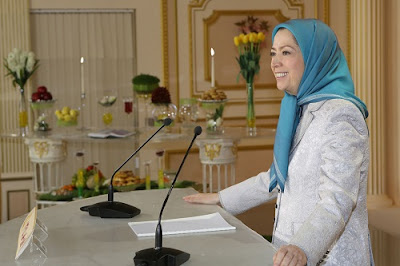
Iran:Persian New Year celebration with residents of Val d'Oise and French supporters of the Iranian Resistance

Maryam-Rajavi-Iran-New-Year
MaryamRajavi: Nowruz strengthens solidarity among people, by overcoming differences and improving friendship, therefore the mullahs are strongly against it
Auvers-sur-Oise, April 3, 2016 – The Persian New Year was celebrated with a number of residents of Val d'Oise and French supporters of the Iranian Resistance at the headquarters of the National Council of Resistance of Iran (NCRI).
Maryam Rajavi welcomed the Auvers-sur-Oise neighbors and supporters from nearby towns.
She elaborated on the philosophy of Nowruz as well as the situation in Iran today and pointed out: The philosophy of these feasts is to strengthen solidarity among people, by overcoming differences and improving friendship.
No wonder that the mullahs are so strongly against Nowruz. They made tremendous effort during their rule to ban Nowruz celebrations, to no avail. Under the mullahs, the Iranian people have celebrated Nowruz more enthusiastically than ever before to show that their culture is greater than what the mullahs advocate. They have thus expressed their hope for change of the mullahs' regime.
In her appraisal of the events of the past Iranian year, the Iranian Resistance's President-elect noted: Our compatriots staged over 6500 large and small demonstrations and protests. Teachers called off school and staged demonstrations in cities all across the country. Workers held numerous demonstrations.
Political prisoners repeatedly went on hunger strike. Families of martyrs and political prisoners held rallies and gatherings outside prisons. Nurses, students, government employees and farmers also held protests on many occasions.
With nearly 1,000 executions over the past year, the total number of executions under Rouhani amounts to 2300, despite his claims to moderation.

Thursday, 10 March 2016

Executions in Iran hit 20-year high in 2015 - UN investigator

Ahmed Shaheed
Ahmed Shaheed
Iran's regime executed nearly 1,000 prisoners last year, the highest number in two decades, the United Nations special rapporteur on human rights in Iran said on Thursday.
AhmedShaheed told a news briefing in Geneva that he is particularly concerned by executions for crimes committed by children under 18. This was "strictly and unequivocally prohibited under international law," he said.
There had been a "staggering surge in the execution of at least 966 prisoners last year - the highest rate in over two decades", Shaheed said.

Wednesday, 10 February 2016

Iran - Tehran - The shining stars and heroines of the Iranian Resistance

The shining stars and heroines of the Iranian Resistance
February8th marks the anniversary of  a fate –making event  in the history of the  Iranian people 's quest for freedom.
On February 8, 1982, Khomeini's Revolutionary Guards surrounded and destroyed the headquarters and killed some of the most prominent leading figures of the PMOI. Khomeini –still alive in those days-- thought that by dealing such a heavy blow to the opposition, he could put up a show of force, demoralize the staunch supporters of the movement and break their resistance in prisons and outside.
It was an unequal battle between thousands of heavily armed guards vs. 20 freedom fighters. He thought victory is certain. However, the champions of freedom did not surrender and fought to the last breath, creating an epical scene that strengthened the movement even further.
The women involved in this battle left a brilliant legacy in the history of the Iranian people's struggle for freedom and democracy. Brave women who did not surrender and resisted and fought courageously to the last breath to herald a new world for their fellow compatriots. Today, their resolve and courage has been multiplied in the ranks of the pioneering women in the PMOI who lead the Resistance movement.

Monday, 25 January 2016

Maryam Rajavi welcomes French mayors to solidarity feast with Iranian Resistance

Maryam Rajavi welcomes French mayors to solidarity feast with Iranian Resistance
Rouhani is travelling to Europe to cover up the regime's weakness and isolation. He is trying to put up a moderate face to cover up the executions in Iran and the mullahs' role in the massacre of Syrians
Dear friends,
Happy New Year! I hope the New Year would be a year of progress and relief for France, a year of peace and tolerance for the world, and a year of overcoming religious dictatorship for the Middle East and Iran.
In the start of the year, let us remember all those who lost their lives as a result of extremist crimes in 2015, including the political prisoners executed in Iran, Camp Liberty martyrs, and victims of terrorist attacks in January and November in France.
Let us pay tribute to them by observing one minute of silence.
I am very pleased to see you, ladies and gentlemen, the mayors and elected representatives of France, here at the headquarters of the Iranian Resistance.  Mayors and elected officials of France are representatives of the most significant institutions of democracy in this country. They have always stood beside the Iranian Resistance and this has been really admirable.
You have protested against violations of human rights and suppression of women in Iran. You have supported Ashraf and Camp Liberty when they were attacked by the Iranian regime's operatives in Iraq. You were at the forefront of the campaign of justice for the Iranian Resistance both in the case of June 17th attack which was terminated last year and the cases of terrorist designations which were reversed in all countries.
The declarations signed by 14,000 mayors and elected representatives of France in support of the Iranian Resistance, are very precious documents. They express the great values of France.
At this point, let us remember the friends who are not among us any more: Adrian Zeller, Mourice Bouscavert and also Abbe Pierre who we commemorate his first anniversary today. They played a valuable role in our struggle.
Also your political stances over the years have been admirable. Time and again, you warned against a number of threats: the mullahs' nuclear weapons; Islamic fundamentalism; violations of human rights in Iran and the mullahs' domination of the region.

Tuesday, 5 January 2016

Iran ; Call by Iranian Resistance to save lives of 16 prisoners on verge of execution

Call by Iranian Resistance to save lives of 16 prisoners on verge of execution
Sunday morning, January 3, the Iranian regime transferred 16 prisoners in Gohardasht (Rajai Shahr) Prison in the city of Karaj to solitary confinement in preparation for their execution. The Iranian Resistance calls on all international human rights bodies to save the lives of these prisoners who are about to be executed. While these prisoners are placed for imminent execution, from December 23 to January 4, thirty-one executions have been registered as follows:
On January 4, one prisoner was hanged in public in Goharbaran Boulevard of Sourak city in Miandoroud in Mazandaran Province while another prisoner was hanged in a prison in Noshahr.
On January 2, Mehdi Ranjkesh, a mentally-handicapped and physically-disabled prisoner was hanged in Khorramabad Prison and two prisoners were hanged in Mashhad’s Central Prison.
On December 26, three prisoners were hanged in Khorramabad in Barsilon Prison. Behrouz Amiri, a married man and father of three who had spent five years in prison, was among them.
Sixteen prisoners were hanged in two mass executions on December 22 and 24 in Qazvin Central Prison. Five prisoners hanged in prison in Kerman on December 24 and two prisoners, 28 and 30 years old, executed in Karaj in Ghezel-Hessar Prison were among other victims of ongoing crimes committed by the Iranian regime.
As the sham elections of its Assembly of Experts and parliament approaches, the religious fascism ruling Iran is unable to confront the loath and escalating popular protests in various cities and is exceedingly resorting to suppressive measures, in particular the cruel death punishment.


Thursday, 31 December 2015

Three prisoners die in Iran prison in consecutive days

prison in Zahedan, southeastern Iran
Torture by Iran’s fundamentalist regime has led to the death of three Iranians in a prison in Zahedan, southeastern Iran, over three consecutive days this week, according to received reports.
The reports indicated that on Sunday, Monday and Tuesday of this week the three prisoners in Wards 5, 6 and 7 of the central prison of Zahedan died due to brutal tortures and denial of medical treatment.
Farzad Naravi, who went by the nickname Shahin and was in his forties, lost his life on Sunday, December 27, three days after he was transferred to Ward 5 of the prison from an interrogation center where he had been brutally tortured. He had serious torture wounds and blood on his back and feet. In prison, he was denied access to medical care.
Mehdi Naravi, 38, died in prison on Monday, December 28. He had spent the past six years behind bars and had been in Ward 7 of Zahedan Prison. For some time, Mehdi Naravi had been ill, but the prison guards deliberately refused to allow his transfer to a hospital.
Gholam Rabbani, 45, who had been imprisoned in Ward 6 of the prison, died on Tuesday, December 29. He too had been ill after spending the past two years in prison, but prison guards had prevented him from receiving proper medical treatment.

Wednesday, 23 December 2015

IRAN - Forozan Abdipour, member of Iran national volleyball team

Forozan Abdipour, member of Iran national volleyball team
to all volleyball fans: In memory of Forozan Abdipour, member of national volleyball  team who was executed in 1988 by the Iranian regime
Ms. Abdi was born in Tehran in 1957. She was the captain of the National Volleyball team and a sympathizer of the PMOI. According to her cellmate, Ms. Abdi was very popular among other inmates.
Her cellmates remember her for her open-mindedness and tolerant attitude towards other political prisoners. In one instance, her cellmate recalls, when a repenting prisoner who was in charge of the cell ordered another prisoner to separate her dishes from the others (because prison authorities treated prisoners who did not believe in God as “unclean”), Ms. Abdi had intervened and stressed that “no one considers the prisoner as ‘unclean’ and whoever does, should separate her own dishes from others”. Ms. Abdi had also kept her athletic spirits during her years of imprisonment and organized volleyball games during the short period when female prisoners had access to a volleyball court at Qezelhesar prison.
Arrest and detention
She was arrested in 1981.
One of her cellmates saying: "I saw her in section 8 of Qezelhesar in 1982. It was a section for special punishment and sometimes there were 25 to 30 people in a cell [that was meant to fit 3]... They placed Foruzan and some others in a restroom in early 1983. The place was so dirty that all of them contracted skin diseases. Then, they were transferred to solitary confinement at both Gohardasht and Qezelhesar prisons where they stayed until early 1986."
Ms. Abdi was protesting against the inhuman rules and behaviour of prison guards. As a result, for almost a year and half (fall 1983 - winter 1984), she was held in solitary confinement and was deprived from recreation time outside, from having contacts with others, reading newspapers, and having regular visits from her family.
Sometime in 1986, Ms. Abdi was transferred from Gohardasht to Evin prison where she was detained until her execution. During this period, she also spent most of her imprisonment in the closed section of the ward that prison authorities used for punishing prisoners. Those held in this section were held in closed cells and were allowed to leave their cells 3 times a day (for 30 minutes), during which time they could use the bathroom, wash their dishes and their clothes.
Forozan Abdipour was executed along with 30 000 other prisoners, mostly PMOI, when the Iranian regime carried out the massacre of political prisoners in the summer of 1988.
Today, women are fighting to enter volleyball stadiums to watch games. Forozan Abdipour, member of national volleyball volleyball team was executed in 1988 by the Iranian regime for wanted all women to live in freedom and democracy.

Tuesday, 22 December 2015

16 executed in Iran in three days after UN General Assembly resolution


16 executed in Iran in three days
The Iranian regime has hanged 16 prisoners in Qazvin, Zahedan, Shiraz and Amol within the past three days.
Eight prisoners were hanged en masse on Tuesday, December 22, in Qazvin Prison. Five prisoners were also hanged en masse in the Central Prison of Bandar Abbas on December 20. Another two prisoners aged 26 and 30 were hanged in public in Kouzegari Square of Shiraz on the charge of Moharebeh, or waging war on God. On December 21, a 31-year-old man was hanged in Amol Prison (northern Iran).
In addition to the above, recorded data show more executions in the past two weeks: Three prisoners were executed in Gohardasht Prison of Karaj and a prisoner in Kerman Prison who had killed a State Security Forces commander (Dec. 16), a 20-year-old prisoner was executed in Noshahr (Dec. 14), a 21-year-old prisoner was hanged in public in Noorabad, Mamasani (Dec. 9), a prisoner was executed in the Central Prison of Bandar Abbas (Dec. 7), a woman was hanged in Qazvin Prison, a group of four prisoners aged between 23 and 35 (including two brothers called Ataollah and Mohammad Gomshad Zehi) were executed in the Central Prison of Zahedan on the charge of clashing with security forces, and another 36-year-old prisoner was executed in Gorgan (Dec. 6).
The Iranian regime executes dissidents and political prisoners using common charges or the charge of waging war on God. Many executions are carried out secretly and the news is never leaked out of prisons and other repressive dungeons.
In the meantime, dozens of prisoners, including Barzan Nasrollahzadeh, Sajjad Sanjari and Hamid Ahmadi who were under 18 years old at the time of their alleged crimes are presently on death row.
Barzan is a Sunni prisoner who was arrested in 2010 when he was a high school student. He was held in solitary confinement for months and ultimately sentenced to death on the charge of Moharebeh. According to Barzan's relatives, "he has not killed anybody, is not affiliated with any group and did not possess any arms."
On December 8, Amnesty International issued a call demanding abolition of death sentences for minors: “Iran cemented its shameful status as the world’s top official executioner of juvenile offenders… Iran’s continued use of the death penalty against persons convicted of crimes committed while they were under 18 years of age is cruel, inhumane and blatantly unlawful.”
Following the December 17th adoption of the 62nd UN General Assembly resolution censuring human rights abuses in Iran, the Iranian Resistance's President-elect Maryam Rajavi called on the UN Security Council to hold the murderers of the people of Iran accountable and prosecute them for their crimes against humanity. She underlined that this is a necessary step towards respecting the international community's vote that condemned the systematic and flagrant violations of human rights in Iran.
Secretariat of the National Council of Resistance of Iran
December 22, 2015

Sunday, 20 December 2015

In a case of RETRIBUTION IN KIND in Iran, the life of a prisoner was spared at the last minute before being hanged by a couple whose son was murdered by him

In a case of RETRIBUTION IN KIND in Iran, the life
The National Observer, Dec. 18, 2015 – Canada’s Minister of Foreign Affairs Stéphane Dion joined the United Nations in calling on Iran to improve its human rights record in a resolution passed by the General Assembly.
The UN resolution expressed “serious concern” at Iran’s high and increasing use of the death penalty without respect for any international safeguards, which resulted in the execution of 694 prisoners between Jan. 1 and Sept. 15 of this year. In addition, the resolution called on Tehran to ensure that prisoners received a fair trial with proper legal counsel and were not subjected to torture or other forms of harsh punishments such as sexual violence for forced confession.
The text of the resolution reflects both the areas where human rights violations continue and those areas where Iran is taking steps to improve the human rights situation,” said Dion.
According to the United States Institute of Peace, Iranian authorities executed 753 people in 2014, noting that executions carried out by the Islamic Republic “have been rising at an exponential rate since 2005.”
Under Iranian law, a wide range of offences carry the death penalty, including murder, drug trafficking, political opposition, espionage, blasphemy or apostasy, adultery, and homosexual acts.
The most common method of execution in Iran is hanging, which is often carried out in public at the scene of a prisoner’s supposed crime. Other methods of execution include stoning to death, shooting and pushing the victim over from a height. Shooting the victim is no longer commonly employed, but in the immediate aftermath of the 1979 Islamic Revolution, thousands of prisoners were shot dead by revolutionary firing squads. There have also been a few cases of prisoners being thrown from cliffs in years past.
Canada and the international community remain deeply concerned about Iran’s human rights record. We call on the government of Iran to implement its human rights obligations to ensure the full enjoyment of human rights for all people in Iran,” said Dion.
In addition to executions, the UN resolution condemned the Islamic Republic’s ongoing persecution of ethnic and religious minorities. It also noted that Tehran continues to restrict freedoms of expression, assembly and association by harassing, prosecuting, and detaining anyone deemed to be an opponent of the Islamic regime.
Canada will continue to speak out about issues of concern such as human rights violations or Tehran’s regional policies,” Global Affairs Canada spokesperson Rachna Mishra said.
Under Stephen Harper’s former Conservative government, Ottawa severed diplomatic relations with Tehran in 2012 and declared Iran to be a state sponsor of terrorism. This policy remained in place even as Iran negotiated with the Americans and Europeans to resolve its nuclear crisis.

Friday, 18 December 2015

UN General Assembly adopts 62nd resolution censuring rights abuses in Iran

UN_General_Assembly
MaryamRajavi: Ruling mullahs who have been condemned 62 times by the UN should be brought to justice for crimes against humanity
On Thursday, December 17, 2015, the UN General Assembly adopted a resolution strongly condemning the brutal and systematic violation of human rights in Iran, in particular the mass and arbitrary executions, increasing violence and discrimination against women and ethnic and religious minorities. This is the 62nd UN resolution condemning rights abuses by the clerical regime.
Mrs. Maryam Rajavi, President-elect of the Iranian Resistance, welcomed the resolution and said: "Mounting violations of human rights in Iran and condemnations of the clerical regime by the highest international body for consecutive years through the past three decades vividly indicates that this regime has no place in the international community and should be rejected by the international community. The murderers of the Iranian people, whose bleak record includes the execution of 120,000 political prisoners and seven massacres in Camp Ashraf and Camp Liberty must be held accountable by the UN Security Council and be brought to justice for crimes against humanity. This is the only way to respect the vote of the majority of countries against human rights abuses in Iran over the past 30 years, especially in light of the fact that most of the current leaders of the regime have held key positions in the past 35 years and have taken part in crimes against humanity.”
"The misguided calculation that by resorting to silence in the face of human rights violations in Iran, the regime's nuclear projects and export of terrorism and fundamentalism could be contained is a dangerous mistake that stems from short-term economic interests and short-sighted political considerations. The clerical regime considers inaction in the face of its crimes against humanity as a green light to continue its tortures and killings and emboldens it in warmongering in Syria, Iraq and the entire region. It reassures the regime that the international community is not serious about confronting its efforts to obtain nuclear weapons," Mrs. Rajavi added.
The resolution expresses “serious concern at the alarming high frequency of, and increase in the carrying-out of the death penalty, in disregard of internationally recognized safeguards, ... and at the continuing imposition and carrying-out of the death penalty against minors and persons who at the time of their offence were under the age of 18” and calls on the Iranian regime “to abolish, in law and in practice, public executions… and executions carried out in violation of its international obligations” and “to ensure, in law and in practice, that no one is subjected to torture or other cruel, inhuman or degrading treatment or punishment.”
The resolution expresses serious concerns about “all forms of discrimination and other human rights violations against women and girls, violence against persons belonging to recognized and unrecognized religious minorities” and calls for the elimination “in law and in practice” of “all forms of discrimination and other human rights violations against persons belonging to ethnic, linguistic or other minorities.”
The resolution also calls upon the regime “to end widespread and serious restrictions… on the right to freedom of expression, opinion, association and peaceful assembly” and “to release persons arbitrarily detained.”
Secretariat of the National Council of Resistance of Iran

December 17, 2015

Monday, 26 October 2015

Iran: Call to save lives of four prisoners who were juvenile offenders

executioner of children
The Iranian regime as the foremost executioner of children in the world sentenced to death four young prisoners in Sanandaj Prison who were juveniles at the time of their crimes. The Iranian Resistance calls on all international human rights agencies, especially the UN Secretary-General, the High Commissioner for Human Rights, and pertinent UN Rapporteurs, as well as the European Union and the U.S. government, to take immediate action to obstruct these cruel executions that contravene many international laws and covenants.
Yousef Mohammadi, 20, and Heeman Orami-nejad, 18, were both 14 years old when they committed their crimes and are now sentenced to death. Siavosh Mahmoudi and Amanej Hosseini (Oveissi) who were arrested when 17 are also at the risk of being hanged. Another young prisoner by the name of Kiomars Nasseiri, also a prisoner in Sanandaj Prison who was arrested when a juvenile, is threatened to be sentenced to death.