Showing posts with label parliament. Show all posts

Saturday, 9 April 2016

IRAN:Excerpts of Amnesty International's 2015/2016 report on violation of human rights in Iran:

Womenremained subject to discrimination under the law, particularly criminal and family law, and in practice.
Women and girls also faced new challenges to their sexual and reproductive health and rights. Parliament debated several draft laws that would further erode women’s rights, including the Bill to Increase Fertility Rates.

Tuesday, 5 April 2016

IRAN: Richard Ashworth MEP: Over 1000 executions in Iran in 2015

richard-ashworth
richard-ashworth
NCRI - Richard Ashworth, a Member of the European Parliament from the United Kingdom, has reiterated that the Iranian regime’s president Hassan Rouhani is not a ‘moderate’ as he claims to be.
Mr. Ashworth, who is a strong supporter of freedom and democracy in Iran, pointed to over 1000 executions carried out in Iran in 2015 under Rouhani’s watch.

Saturday, 5 March 2016

Maryam Rajavi speaks in Women's Role in War against Fundamentalism conference Conference in the European

Maryam Rajavi speaks in Women's Role in War against Fundamentalism
 conference Conference in the European
Below is excerpts of the speech by Mrs. Maryam Rajavi, the President-elect of the Iranian Resistance at Conference entitled Women's Role in War against Fundamentalism held on 2 March 2016 in the European Parliament and chaired by Beatriz Becerra, member of EP’s Committee on Women's Rights and Gender Equality:
Maryam Rajavi:
Extremism under the banner of Islam is a fatal epidemic expanding throughout the world because it has not been confronted. To defeat this epidemic, a comprehensive approach is vital.
Since the 1990s we have been warning that Islamic fundamentalism is the new global threat.
Today, there is a real concern about Daesh, but it should be noted that its expansion is a product of two developments in the region:
The Iranian regime's occupation of Iraq after the war in 2003 and the brutal crackdown on Sunnis by the mullahs' puppet government in Iraq.
Suppression of Syrian people and dissidents by Bashar Assad's government, backed and led by the mullahs' regime.
Therefore, if it was not for the Iranian regime's domination over Iraq and Syria, if the Sunnis were not suppressed in Iraq, if Bashar Assad's dictatorship did not exist, Daesh would not have emerged as a threat.
With the inception of the mullahs' rule in 1979, a concrete, practical model was created for all fundamentalist groups. The history of the past 37 years proves that no other factor has been as effective as a ruling government acting as a role-model for the expansion of fundamentalist groups. Particularly that the mullahs actively try to create these groups and guide them ideologically.

Tuesday, 1 March 2016

IRAN:Maryam Rajavi: No Real Choice In The Iran 'Elections'

Maryam-Rajavi
Maryam-Rajavi
This week Iran will hold two concurrent “elections,” one for the Majlis (parliament) and the other for the Assembly of Experts, whose theoretical mandate is to select the supreme leader. To those who live and vote in democracies, the irony of these parallel acts is obvious: They take place in a theocratic system whose bedrock principle is absolute clerical rule (velayat-e faqih).
Democratic elections, where people are afforded a real choice to pick their leaders, are non-existent in today’s Iran; the genuine opposition has no  voice. What currently exists is a constricted power struggle through sham elections whose outcome is shaped not by popular vote but by the regime’s internal balance of power.
All candidates in the regime are required by law to exhibit “heart-felt and practical allegiance” to absolute clerical rule as a prerequisite for their candidacy. Even then, the faithful will have their qualification determined by the Guardian Council whose six clerics are installed by the supreme leader while the remaining six jurists are appointed by the head of the judiciary who himself is selected by the supreme leader.
The regime’s supreme leader Ali Khamenei has also formed a special committee consisting of his own chief of staff, the commander of the Islamic Revolutionary Guard Corps (IRGC), the IRGC commander of Tehran and the secretary of the Guardian Council. This committee’s supreme power trumps that of the Guardian Council. Its mission is to purge, or at least dramatically undermine the rival faction from the elections, thus safeguarding Khamenei’s power.

Tuesday, 5 January 2016

Iran ; Call by Iranian Resistance to save lives of 16 prisoners on verge of execution

Call by Iranian Resistance to save lives of 16 prisoners on verge of execution
Sunday morning, January 3, the Iranian regime transferred 16 prisoners in Gohardasht (Rajai Shahr) Prison in the city of Karaj to solitary confinement in preparation for their execution. The Iranian Resistance calls on all international human rights bodies to save the lives of these prisoners who are about to be executed. While these prisoners are placed for imminent execution, from December 23 to January 4, thirty-one executions have been registered as follows:
On January 4, one prisoner was hanged in public in Goharbaran Boulevard of Sourak city in Miandoroud in Mazandaran Province while another prisoner was hanged in a prison in Noshahr.
On January 2, Mehdi Ranjkesh, a mentally-handicapped and physically-disabled prisoner was hanged in Khorramabad Prison and two prisoners were hanged in Mashhad’s Central Prison.
On December 26, three prisoners were hanged in Khorramabad in Barsilon Prison. Behrouz Amiri, a married man and father of three who had spent five years in prison, was among them.
Sixteen prisoners were hanged in two mass executions on December 22 and 24 in Qazvin Central Prison. Five prisoners hanged in prison in Kerman on December 24 and two prisoners, 28 and 30 years old, executed in Karaj in Ghezel-Hessar Prison were among other victims of ongoing crimes committed by the Iranian regime.
As the sham elections of its Assembly of Experts and parliament approaches, the religious fascism ruling Iran is unable to confront the loath and escalating popular protests in various cities and is exceedingly resorting to suppressive measures, in particular the cruel death punishment.


Saturday, 2 January 2016

Iran regime plans to forcibly turn Tehran church grounds into mosque

church-iran
Authorities in Tehran are planning to transform illegally-confiscated church grounds into an ‘Islamic prayer center.’
The land belonging to the Iranian Assyrian community’s Chaldean Catholic Church in Tehran’s Patrice Lumumba Street (in Western Tehran) was illegally confiscated two years ago under the pretext of constructing an Islamic prayer hall and the authorities have refused to hand it back, a member of the regime's Majlis (Parliament) was quoted as saying by the state-run newspaper Sharq on Wednesday, December 30.
Repeated complaints about the illegal confiscation of the church grounds have fallen on deaf ears despite repeated pleas by the representatives of the Christian minority, said Jonathan Bet-Kelia, a member of the regime’s Majlis.
Bet-Kelia told Sharq that he had approached Ali Younesi, special assistant to the regime's President Hassan Rouhani on ethnic minorities affairs, on this matter but was told that nothing could be done about it. Younesi is a former Minister of Intelligence and Security (MOIS) and is personally responsible for ordering numerous arrests and assassinations of dissidents.
Commenting on the regime's admission that it had usurped church grounds to build its own prayer hall, Ali Safavi of the Foreign Affairs Committee of the National Council of Resistance of Iran (NCRI) said: “The brazen admission displays first and foremost the discriminatory and sectarian policies of the regime vis-à-vis Iran’s religious minorities. At the same time, it speaks to the failure of Western policy to accommodate the regime in the futile hope that it will promote moderation and tolerance on the domestic front.”

Wednesday, 23 December 2015

Iran: Revision court held for Atena Faraghdani

Atena Farghadani
Atena Farghadani
The appeals court of civil activist Atena Farghadani, currently detained in Tehran’s notorious Evin Prison, was held on Sunday, December 29.
Her lawyer, Mohammad Moghimi, has said he met with his client on December 15 in Evin Prison in order to prepare her defense. Farghadani, imprisoned since January 10, was sentenced to 12 years and 9 months behind bars in a court chaired by judge Salavati.
Her charges include “insulting members of parliament through drawings,” “assembly and collusion with anti-revolution figures” and “insulting the leader of the Islamic republic”.
Farghadani said earlier this year after being held in a Revolutionary Guards prison for two months that her critical drawings were the main subject of the interrogations. She is currently being held in the women’s ward of Evin Prison.

Tuesday, 15 December 2015

West must end wrong policy toward Iran: Ex Prominent European lawmaker

Dr. Alejo Vidal-quadras, former vice-president of the European Parliament
Dr.Alejo Vidal-quadras, former vice-president of the European Parliament and current president of In Search of Justice NGO, at a conference entitled “United Against Islamic Fundamentalism,” held in Paris on 8 December 2015.
We have to admit that what this happened at least from the 9/11 tragedy onwards was predicted by the Iranian Resistance long time ago.
They had shown us the solution, in early 90s, when the term “Islamic fundamentalism” was not even familiar to many people.
They declared – the PMOI [The People’s Mojahedin Organization of Iran] – they declared the Islamic fundamentalism as the new global threat.
My distinguished friend Mohammad Mohaddessin, wrote a book under this title, more than 20 years ago; a book that I strongly recommend, really, because many of his insights are still valid today. But the western analysts were saying it was an exaggeration. Unfortunately, the biter reality of 9/11 proved that Mohammad Mohaddessin and the PMOI were right.
But again, the United States and Europe took a wrong path and instead of focusing on the heart of this evil phenomenon, which is the regime in Tehran, they deviated their attention onto other problems and objectives.
Twelve years ago, Mrs. Rajavi warned that the threat of the mullahs interference in Iraq is many times more dangerous that their nuclear bomb. But there was no one to listen. We have opened, naively, Iraq’s gates to Iranian influence and control.
Despite many warning by the PMOI, we closed our eyes on the invasion of Iraq by the Iranian regime. This broad regime, hundreds of kilometers closer to Israel, and the Mediterranean had increased its influence in Lebanon and in Syria. Had we got the regime’s hands in Iraq at the time, we wouldn’t have Daesh today, nor would we have Assad or Hezbollah in Syria.
Very recently, hundreds of thousands of Iranians have crossed the Iraqi borders in a large operation of invasion organized by the Quds Force and led by General Soleimani.
In spite of all that, we see high representatives Federica Mogherini or Secretary John Kerry or many ministers of Western governments rush to Tehran to appear in photographs shaking hands and smiling to the Iranian authorities.
In Spanish we have a saying that says in English “there is no worse blindness as that of those who do not want to see”. And this is what is happening. What Senator Lieberman said to us some minutes ago, was so clear, so convincing, so… it was so impossible to deny. But I’m sure if he has a conversation on this with President Obama or Secretary Kerry, a conversation that he can’t obviously have, I’m sure they would not listen. Because in Europe we have the same problem. Governments, do not listen. The PMOI has a large support in parliamentarians. And also in local authorities as well. But governments do not listen. This is something we must change and perhaps you can guide us in how to make governments listen.
Today, we must put an end to this wrong policy. Anything that would bolster Iranian terrorism, be it Shiites or Sunnis, anything that prolongs the life of Assad will reinforce Daesh.
Nobody has paid the price that the PMOI, a truly democratic movement, and President Rajavi have paid in fighting against Islamic fundamentalism. No one is so much familiar with the geography and history of the people of these regions, and with Sunnis and with Shiites Muslims. They have been fighting against religious dictatorship for 37 years. So, if we do not listen to their call today after all these tragedies, history will not forgive us.

Friday, 11 December 2015

British MPs demand sanctions against human rights abusers in Iran

British MPs demand sanctions against human rights abusers in Iran
On the occasion of International Human Rights Day, December 10, cross-party MPs from both Houses of Parliament held a conference in the House of Commons discussing the state of human rights and the current political situation in Iran, the region as well as a recent terrorist attack on Camp Liberty.
Speakers at the conference that was chaired by co-Chairman of the British Parliamentary Committee for Iran Freedom (BPCIF), Lord Carlile of Berriew QC, included: Rt Hon. David Jones MP; Steve McCabe MP; Bob Blackman MP; Jim Shannon MP; Rt Hon. Lord Dholakia; Lord Clarke of Hampstead CBE; Lord Maginnis of Drumglass; Lord Cotter; Lord Judd; Peter Carter QC, Bar Human Rights Committee of England and Wales; Peter Mathews TD, Independent member of the Irish Parliament; Paulo Casaca, former MEP; Mrs Dowlat Nowrouzi, NCRI UK Representative and Linda Lee, former President of the Law Society of England and Wales.
In her remarks to the conference, President-elect of the National Council of Resistance of Iran (NCRI), Mrs Maryam Rajavi, thanked the MPs from both Houses of Parliament for their efforts to promote human rights in Iran and said ”The mullahs’ brutality in violating our people’s rights is because they want to hold on to power. It’s because the people of Iran … have not surrendered to this barbarism [and] staged a widespread resistance against the regime. Every month, teachers, students, workers and other strata stage hundreds of protests. Every day, the protests become louder. Even political prisoners send messages from inside the jails calling on people to resist … [these] protests have inspired many uprisings so far will ultimately realise the great change and make Iran the cradle of human rights and freedom.”
On Camp Liberty, Mrs Rajavi said, “Since 2009, 141 PMOI members have been killed and hundreds more, seriously wounded or disabled in these attacks … It is time for US and UN to fulfill their promise and make sure residents are allowed to sell their property at Camp Ashraf to finance their relocation.”

Friday, 27 November 2015

Women in History

Nancy Astor
Nancy Astor
-1919- Nancy Astor was elected a Member of the Parliament of the United Kingdom. She was the first woman to sit in the House of Commons.
Nancy Witcher Langhorne Astor (19 May 1879 – 2 May 1964), rallied the supporters of the incumbent government, moderated her Prohibition views, and used women's meetings to gain the support of female voters. A by-election was held on 28 November 1919, and she took up her seat in the House on 1 December as a Unionist (also known as "Tory") Member of Parliament. Astor's friendship with George Bernard Shaw helped her through some of her problems, although his own nonconformity caused friction between them. They held opposing political views and had very different temperaments. However, his own tendency to make controversial statements or put her into awkward situations proved to be a drawback for her political career. Astor was challenged by the rise of Nazism. She criticized them for devaluing the position of women, but was strongly opposed to the idea of another World War. Lady Astor died in 1964 at her daughter Nancy Astor's home at Grimsthorpe Castle in Lincolnshire.

Wednesday, 28 October 2015

Rafsanjani’s admissions: In the beginning we were looking to have such a capability to acquire nuclear bomb.

atom-akhoond
atom-akhoond
Khamenei and Rafsanjani personally wanted to meet Abdul Qadeer Khan
Quarter of a century later, Rafsanjani confirms Iranian Resistance’s disclosures of regime’s nuclear project
IAEA is unable to determine PMD without interviewing Rafsanjani and Khamenei
Ali Akbar Hashemi Rafsanjani, former Iranian regime President and present head of regime’s State Exigency Council that has been regime’s No. 2 man from the outset made unprecedented concessions in an interview that the regime was looking to acquire nuclear bomb when it initiated its nuclear program and has never abandoned the idea.
According to this interview published by regime’s official news agency IRNA on 26 October 2015, Rafsanjani in the capacity of speaker of parliament or President and Khamenei as President or Supreme Leader of this regime have been personally following up the project to acquire the nuclear bomb. Moreover, Rafsanjani has acknowledged that from the onset there has been a comprehensive clandestine nuclear plan, including construction of secret sites, enrichment of uranium, manufacture of centrifuge parts, laser technology, and the heavy water reactor.

Tuesday, 20 October 2015

Firouz Mahvi: Global solidarity needed with Iranian people

Mr. Firouz Mahvi, member of the National Council of Resistance of Iran (NCRI)
Mr. Firouz Mahvi, member of the National Council of Resistance of Iran (NCRI), at a meeting on October 7 on human rights in Iran at the European Parliament in Strasbourg.
As you know Iran executes more people in the world than any other country except China. But it is number one per capita, with over 2000 executions since HassanRouhani became president. This is not nothing to be proud of. The regime claims that these people are drug traffickers. The reality is that many young people who are protesting against the mullahs are executed under this excuse. Several political prisoners have been hanged recently. Many executions are done in public. This creates an atmosphere of fear and terror.

At the same time repression against women has increased under Rouhani. Apart from many acid attacks, there are many repressive regulations imposed on women. Last week a new video clip appeared on YouTube which showed that in a marriage ceremony, the security forces in Iran arrested the bride and took her to prison because she did not dress properly. The regime interferes in the private lives of the people every day. Several women activists have recently received long-term prison sentences.

Friday, 16 October 2015

Edmond Spaho: Albania supports democracy in Iran

Edmond-Spaho
Edmond-Spaho
Edmond Spaho, Vice President of the Albanian Parliament, says he and his country will always support the Iranian people and Resistance in their struggle for freedom anddemocracy in Iran.
"I know that 120,000 political activists have been executed in your country [Iran] for their belief in democracy," Mr. Spaho told a major conference in Paris on human rights in Iran on October 10 on the occasion of the World Day Against the Death Penalty. He was referring to the 120,000 members and supporters of the main Iranian opposition People’s Mojahedin Organization of Iran (PMOI, or MEK).
"I also know that under [Hassan] Rouhani, the so-called moderate president of the regime, 2000 people have been executed in just two years."
"I know freedom of speech does not exist in your country at all. I know that freedom of religion also means nothing" in Iran.

Thursday, 8 October 2015

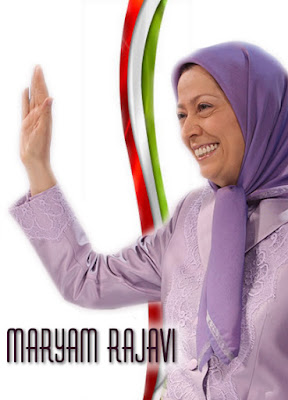
A glimpse at the life of Maryam Rajavi

Maryam Rajavi

Maryam Rajavi
Maryam Rajavi
Date of Birth: December 4, 1953
Place of Birth: Tehran, Iran
Education: B.S. Degree in Metallurgy from Sharif University of Technology in Tehran
Current Profession:President-elect of the National Council of Resistance of Iran (NCRI)
Political career:
An organizer of the anti-Shah student movement, 1973-1979;
An official of the social section of the People’s Mojahedin Organization of Iran (PMOI/MEK), 1979-1981;
Parliament candidate, 1980;
Joint-leader of the PMOI, 1985-1989;
Secretary General of the PMOI, 1989-1993;
President-elect of the National Council of Resistance of Iran (NCRI), the Parliament-in-exile, 1993 to the present.
Leading the Resistance Movement:
In her new position as the President-elect of the Iranian Resistance, Maryam Rajavi, presents a formidable political, social, cultural and ideological challenge to the ruling mullahs.
Under her direction, women assumed the key positions within the ranks of the Resistance. Women make up half the members of the NCRI. They have various responsibilities in the resistance’s political, international, social and cultural affairs.
Rajavi has given extensive lectures on modern and democratic interpretations of Islam as opposed to the reactionary, fundamentalist interpretation of the religion. In her view, the most prominent distinction between these two diametrically opposed viewpoints centers around their outlook on women.
Islam, Women and Equality” and “Women, the Force for Change” are publications based on her different speeches in conferences around the world.
She has also brought attention to Iran's rich, but endangered, artistic and cultural heritage. Many famous performers, filmmakers, artists, painters, sculptors, poets and writers have expressed their support for her platform for a free and secular Iran.
Women Against Fundamentalism
In March 2013, on International Women’s Day, Mrs. Rajavi presented her latest book, entitled “Women Against Fundamentalism” written in French. The book is a compilation of the experiences of women in the Iranian Resistance in the struggle against Islamic Fundamentalism.


Friday, 2 October 2015

Euro-Parl VP: Europe should speak out on Iran’s appalling rights record

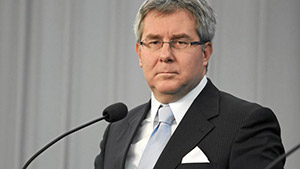
Ryszard Czarnecki
Ryszard Czarnecki

Huffington Post


Vice President of the European Parliament
A lot has been said about the nuclear agreement signed between EU3+3 and Iran in summer. But problems with Iran are far from being over. One area that should be of major concern is Iran's conduct in the area of human rights.
Iran under President Rouhani hascarried out some 2,000 executions over the past two years, according to opposition figures.

Some victims who were lucky enough not to be hung on giant cranes (incidentally manufactured by European countries which trade with Iran) whose purpose is not to build, but to destroy lives, have suffered forced amputations and blinding.